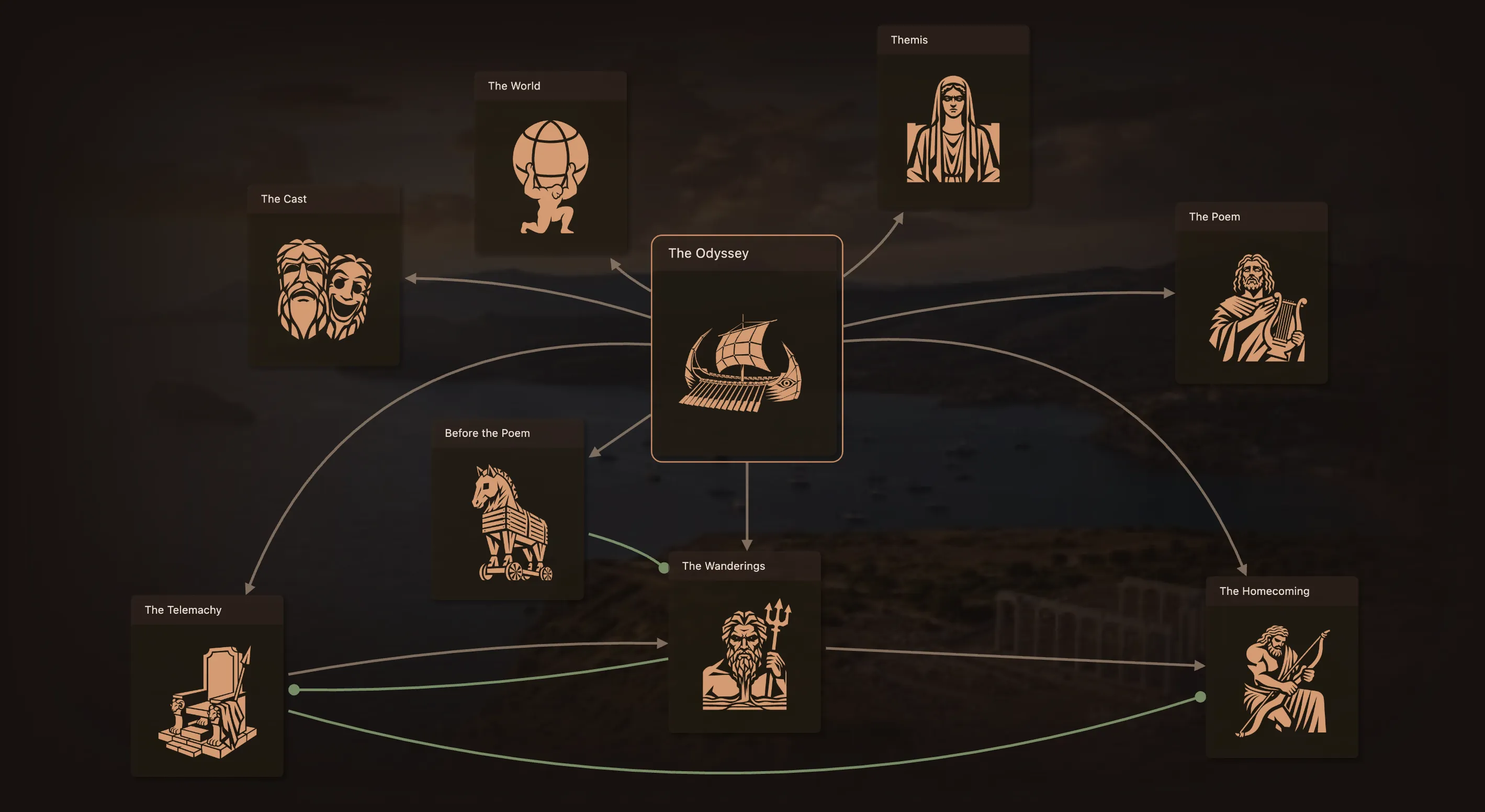
Homer's epic as a map rather than a line — the Telemachy, the wanderings, and the homecoming, with the household waiting on Ithaca, the gods arguing above it, and the moral order the whole poem turns on. Walk the story in the order it happens, or in the order Homer tells it, and see why the two are not the same.
Opens in the browser — no account, nothing to install. Yours to edit once it's open,
or download the file to keep.
Graphs are built for a large screen — open this one on a desktop computer.
The Odyssey does not begin at the beginning. It opens in the tenth year with the hero absent,
spends four books following his son around the Peloponnese, and then hands the best-known
adventures — the Cyclops, Circe, the underworld — to Odysseus himself, told in flashback to
strangers at a dinner party. It is a magnificent piece of construction and it is murder on a
first-time reader. Somewhere around the raft you lose track of what is happening now and what is
being remembered, and the poem quietly becomes a sequence of famous scenes with no thread
between them.
A map fixes that, because it can hold the story and the telling at the same time. Before the
Poem keeps what happened before line one — Troy, the wooden horse, the ten years nobody sings
about. The Telemachy, The Wanderings and The Homecoming are the three movements as Homer
arranged them. Cutting across all of it are the branches a reader actually needs alongside the
plot: The Cast, so you can see the whole household at once rather than meeting Eurycleia
seventy pages after Eumaeus; The World, for the geography of a sea that is half real and half
invented; and Themis, for the code of hospitality, oath and obligation that turns a story about
sailing into a story about what the suitors did wrong.
Then it keeps going past the last line. Dante puts Ulysses in hell for the voyage Homer never
mentions, Tennyson makes him a restless old man, Joyce makes him an advertising canvasser in
Dublin. Those sit in the graph next to the character they descend from, which is the only
sensible place for them and almost never where a syllabus puts them.
Open it beside whatever translation you are reading. Follow Odysseus through his own scene when
you want the man, follow the three movements when you want the plot, and use quiz mode when you
want to know whether the names have stuck. It assumes no Greek and no prior reading. Line-by-line
commentary, textual scholarship and the Homeric question are deliberately outside it — this is
the shape of the poem, not a replacement for it.
What's in this graph
The map opens on The Odyssey. These are the concepts branching from it — open one to
see the concepts inside it.
written article or notes
The Cast
The gods, mortals, and creatures who take part in the events of the epic.
8 children · 52 grandchildren · 9 neighbours
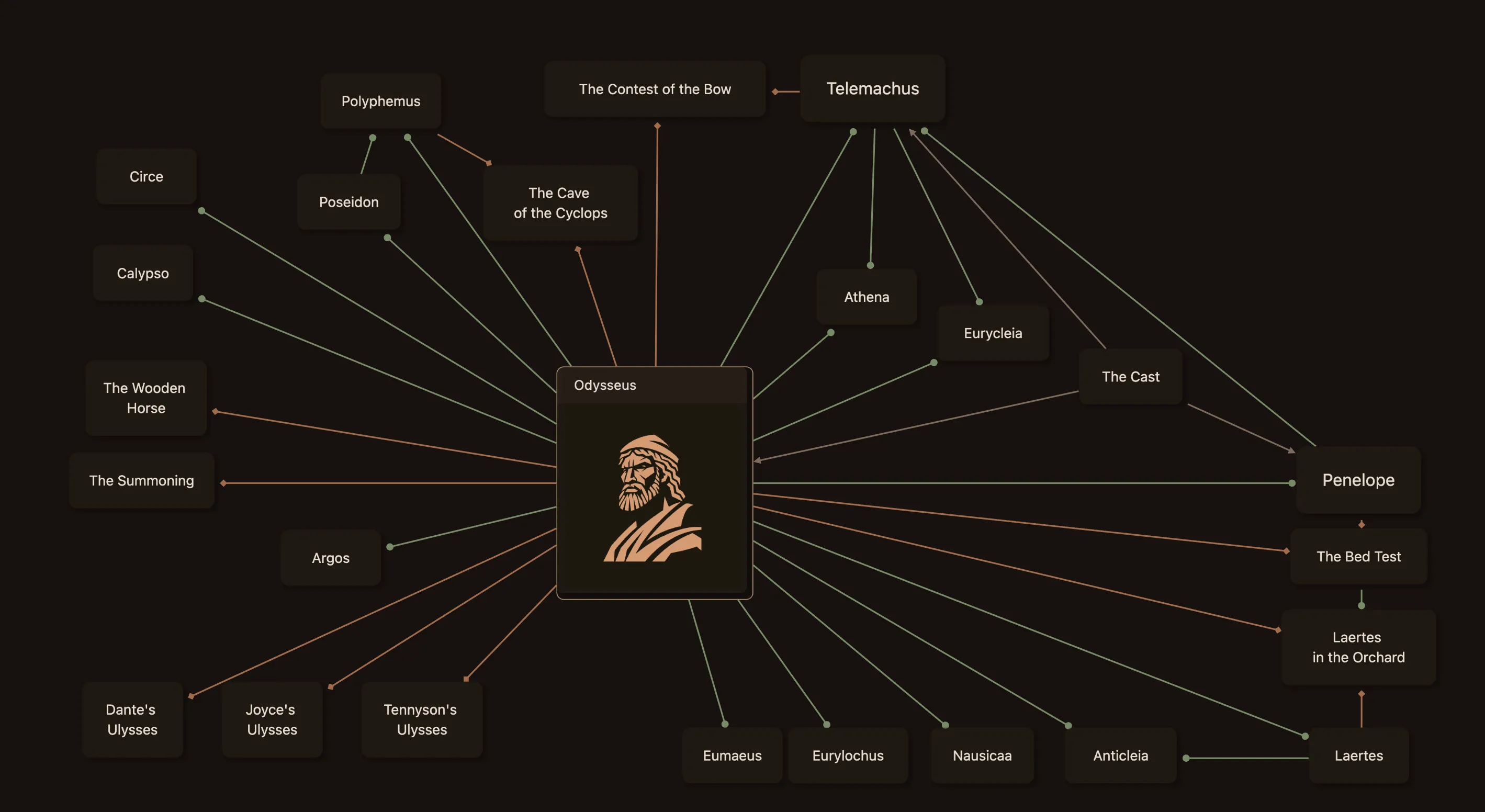
Odysseus
The king of Ithaca and central figure of the epic, known for endurance and for cunning intelligence.
The hosts, helpers, and adversaries whom Odysseus encounters between Troy and Ithaca.
4 children: Aeolus, Elpenor, The Phaeacians, Tiresias
8 grandchildren · 9 neighbours
The Gods
The divine figures who assist or obstruct the return.
3 children: Helios, Hermes, Ino
5 grandchildren · 8 neighbours
The House of Odysseus
The family and servants of the royal household on Ithaca.
3 children: Melanthius, Melantho, Philoetius
4 grandchildren · 9 neighbours
The Suitors
The young noblemen occupying Odysseus's house while pressing his wife to marry one of them.
3 children: Amphinomus, Eurymachus, Irus
3 grandchildren · 6 neighbours
Penelope
The wife of Odysseus, who holds his household together through twenty years of absence by delay and stratagem.
1 child: The Penelopiad
2 grandchildren · 9 neighbours
Telemachus
The son of Odysseus and Penelope, an infant when his father sailed for Troy and a young man when he returns.
10 neighbours
The Great Houses
The ruling families of Pylos, Sparta, and Mycenae, whose own returns from Troy are recounted within the epic.
8 neighbours
The Telemachy
The first four books of the epic, following Odysseus's son as he confronts the men occupying his house and travels in search of news of his father.
9 children · 24 grandchildren · 13 neighbours
Council of the Gods
An assembly of the gods on Olympus at which Zeus and Athena determine that Odysseus's exile shall end, held while Poseidon is absent among the Ethiopians.
5 children: Seven Years on Ogygia, Athena, Olympus, The Second Council, Zeus
16 grandchildren · 9 neighbours
Nestor at Pylos
The reception of Telemachus by the aged king Nestor, who recounts the Greek departures from Troy and the killing of Agamemnon on his return.
The visit of Telemachus to the hall of Menelaus and Helen, who identify him by his resemblance to his father.
3 children: Helen, Menelaus, Sparta
4 grandchildren · 10 neighbours
The Assembly at Ithaca
A public meeting called by Telemachus to demand that the suitors leave his father's house, the first assembly held on Ithaca since Odysseus sailed for Troy.
2 children: Antinous, Ithaca
5 grandchildren · 8 neighbours
Penelope's Shroud
A stratagem by which Penelope postponed remarriage for three years, weaving a burial shroud by day and unravelling it by night until a servant disclosed the deception.
1 child: Loyalty and Betrayal
4 grandchildren · 7 neighbours
The Ambush at Asteris
A plan by the suitors to intercept and kill Telemachus with an armed ship stationed in a strait on his route home.
1 child: The Return of Telemachus
3 grandchildren · 5 neighbours
The Old Man
of the Sea
An account given by Menelaus of ambushing the shape-shifting sea god Proteus, who reported that Odysseus was alive and detained on a distant island.
1 child: Proteus
1 grandchild · 7 neighbours
Athena at the Gate
A visit by the goddess Athena to Ithaca in the guise of a foreign captain named Mentes, who urges Telemachus to act on his own behalf and seek news of his father.
6 neighbours
The Secret Sailing
The night departure of Telemachus from Ithaca with a ship and crew arranged by Athena, undertaken without his mother's knowledge.
7 neighbours
Themis
The ancient Greek concept of established custom and right order, covering what gods and men alike are bound to uphold.
4 children · 24 grandchildren · 5 neighbours
Kleos
The ancient Greek term for the fame that outlives a man, won by great deeds and preserved in song.
2 children: Achilles Among the Dead, Mortality
5 grandchildren · 6 neighbours
Metis
The ancient Greek term for cunning intelligence, the practical shrewdness that solves by craft what force cannot.
1 child: Disguise and Recognition
6 grandchildren · 7 neighbours
Xenia
The ancient Greek obligation binding host and guest, requiring shelter, food, and gifts before questions are asked, and protected by Zeus.
2 children: Justice and Revenge, Type-Scenes
4 grandchildren · 9 neighbours
Nostos
The ancient Greek term for homecoming, meaning the safe return of a man from war or voyage to his own household and land.
1 child: The Temptation to Forget
2 grandchildren · 8 neighbours
The Homecoming
The last twelve books of the epic, covering Odysseus's arrival on Ithaca in disguise, the testing of his household, the killing of the suitors, and the restoration of his position.
4 children · 18 grandchildren · 7 neighbours
The Beggar in the Hall
The sequence in which the disguised Odysseus enters his own palace, endures the abuse of the suitors, and is questioned by his wife.
5 children: Home in Disguise, Penelope's Interview, The Dream of the Geese, The Fight with Irus, The Scar
12 grandchildren · 10 neighbours
The Reckoning
The sequence in which a contest of archery puts Odysseus's own bow into his hands and the suitors and disloyal servants are killed.
3 children: The Contest of the Bow, The Maids, The Slaughter
14 grandchildren · 8 neighbours
The Return to Ithaca
The sequence in which Odysseus is landed on his own island, takes on the appearance of a beggar, and makes himself known to his son.
5 children: Father and Son, The Beggar's Disguise, The Phaeacian Ship, The Ship Turned to Stone, The Swineherd's Hut
12 grandchildren · 9 neighbours
The Restoration
The closing sequence of the epic, in which Odysseus is recognised by his wife and his father and the quarrel with the suitors' families is ended.
4 children: Athena's Peace, Laertes in the Orchard, The Bed Test, The Second Nekyia
10 grandchildren · 7 neighbours
The Poem
The epic considered as a made object, in its verse technique, its origins, and its later influence.
3 children · 17 grandchildren · 4 neighbours
The Afterlife
The works of later literature and film that retell, answer, or draw upon the epic.
5 children: English Translations, Miller's Circe, O Brother, Where Art Thou?, The Aeneid, The Odyssey (2026)
1 grandchild · 10 neighbours
The Craft
The techniques of composition out of which the epic is built.
4 children: Dactylic Hexameter, Epithets, In Medias Res, Oral Composition
6 neighbours
The Origins
The questions of who composed the epic, when it took its present form, and how it stands in relation to the other surviving Greek epic.
3 children: Homer, The Homeric Question, The Iliad
4 neighbours
The Wanderings
Books five through twelve of the epic, covering Odysseus's release from Calypso's island, his arrival among the Phaeacians, and the account of his voyage that he delivers there.
3 children · 11 grandchildren · 8 neighbours
Odysseus's Tale
The four books in which Odysseus, speaking in his own voice before the Phaeacian court, narrates the years of voyaging between Troy and Calypso's island.
3 children: The Last Voyage, From Troy to Aeaea, The Underworld
19 grandchildren · 6 neighbours
Among the Phaeacians
The reception of Odysseus on the island of the Phaeacians, where he is fed, clothed, entertained, and finally promised passage home.
3 children: The Court of Alcinous, Demodocus Sings, The Meeting on the Shore
10 grandchildren · 7 neighbours
Leaving Ogygia
The sequence in which the gods order Odysseus's release from Calypso's island and he sails alone on a raft until a storm destroys it.
4 children: Calypso's Offer, Hermes at Ogygia, Ino's Veil, The Raft
9 grandchildren · 9 neighbours
Before the Poem
The events preceding the epic's opening lines, known to the reader through the recollections of characters rather than through direct narration.
4 children · 9 grandchildren · 6 neighbours
Poseidon's Grudge
The anger of the sea god Poseidon toward Odysseus for the blinding of his son, which keeps the hero from reaching his home for years.
2 children: The Boast, Poseidon
9 grandchildren · 3 neighbours
The Nostoi
The homeward voyages of the Greek commanders after the fall of Troy, which ended variously in safe arrival, long wandering, or murder.
1 child: Agamemnon
7 grandchildren · 4 neighbours
The Wooden Horse
A hollow wooden horse devised by Odysseus, in which Greek warriors concealed themselves to enter Troy and open the city to their army.
2 children: The Cicones, Troy
4 grandchildren · 8 neighbours
The Trojan War
A ten-year siege of the city of Troy by a coalition of Greek kings, ended by the city's capture and sack.
3 neighbours
The World
The places in which the epic's events occur, from familiar Greek harbours to regions beyond any map.
2 children · 11 grandchildren · 3 neighbours
The Uncharted World
Those regions Odysseus reaches after being blown off course, none of which can be placed on any map.
6 children: Aeaea, Ogygia, Scheria, The House of Hades, The Land of the Cyclopes …
11 grandchildren · 7 neighbours
The Mapped World
Those locations of the epic that lie within the world Greek sailors knew and could name.
6 neighbours
The shape of this map
A tree linking 165 ideas would need 164
connections. This map has 422. The extra 258 open alternative routes throughout.
The map runs 4 levels deep from its root. Any two ideas are about 3.6 steps apart, and the two most distant are 7.
Neighbouring ideas are linked to each other 19% of the time — themes hold together rather than radiating separately.
Connections are typed, not plain lines. They come in 7 kinds: Consists of, Appears in, Precedes, Precedes in text, Embodies, Bound to, related.
Most routes through the map pass through Odysseus, The Cast, The Poem, Xenia, The Afterlife, The Craft.
One node from the map
The Odyssey
That is the first thing to understand about the Odyssey, and almost everything else follows from it. The great deed is done, the city is ash, and the poem opens ten years later. Nothing important is going to be conquered. This poem is about what comes next.
Greek tradition once held a whole cycle of epics about the Trojan War — its causes, its battles, the horse, the sack, the voyages home. Every one of them is lost, surviving only as titles and summaries. Of that entire literature, two poems came through: one about a quarrel between commanders in the war's ninth year, and one about a man walking home afterwards. The war poems did not survive. The poems about what war does to people did.
The two survivors announce their difference in their opening words. The Iliad begins, in Greek, with wrath. The Odyssey begins with man — not a name, just the noun, thrown forward, and the hero goes unnamed for twenty more lines. A man, any man, trying to get back to his house.
The poem builds that return from very old material — the sea voyage, the ogre outwitted, the husband coming home in disguise on the day his wife must remarry. These patterns are older than Troy and wider than Greece. What the poem does with them is new: not the battle but the return; not the deed but the twenty-year consequence; not the taking of a city but the question of whether a man who has spent a decade taking cities can be a husband again. …
This continues inside the graph, along with 164 other nodes.