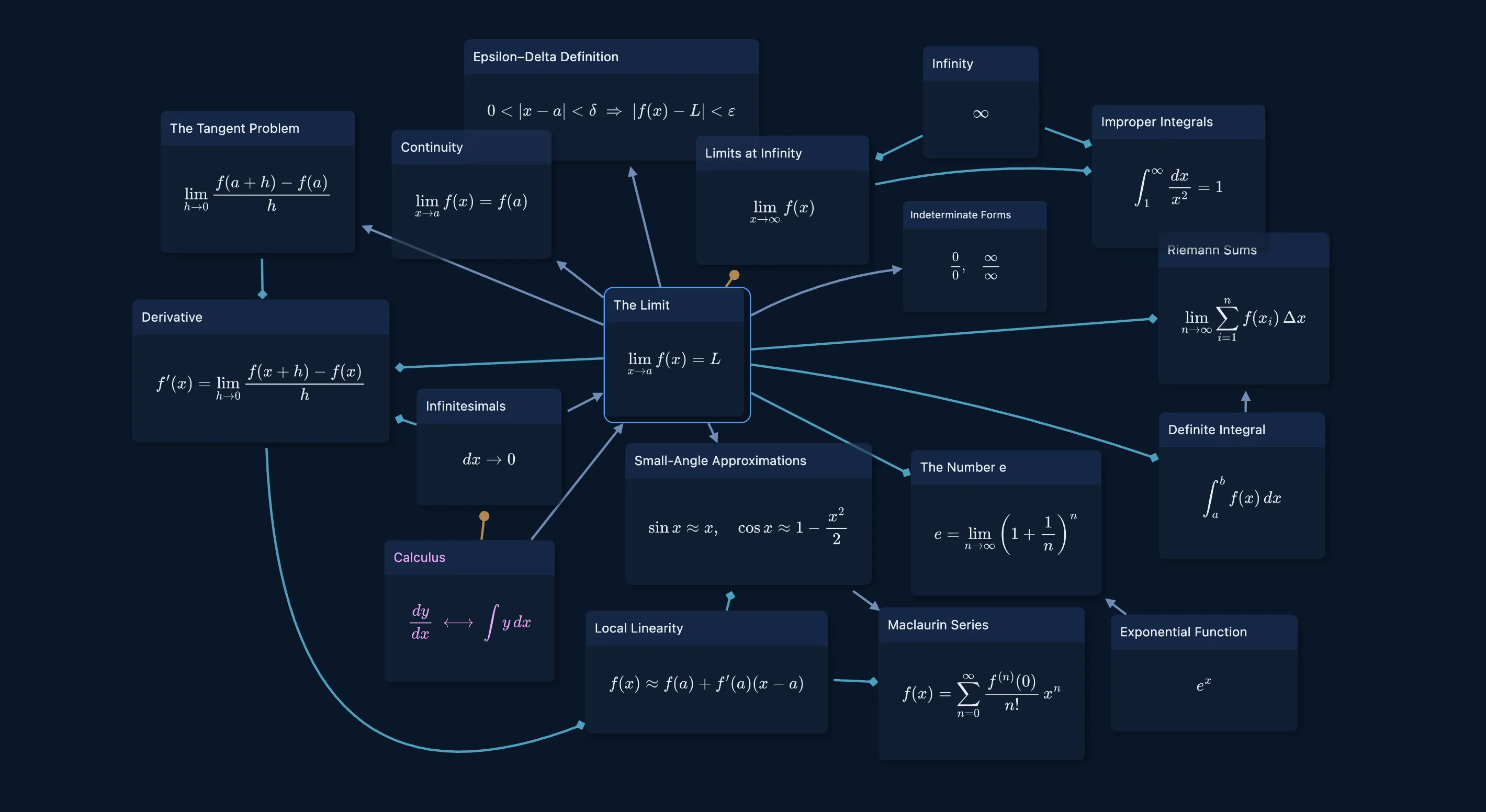
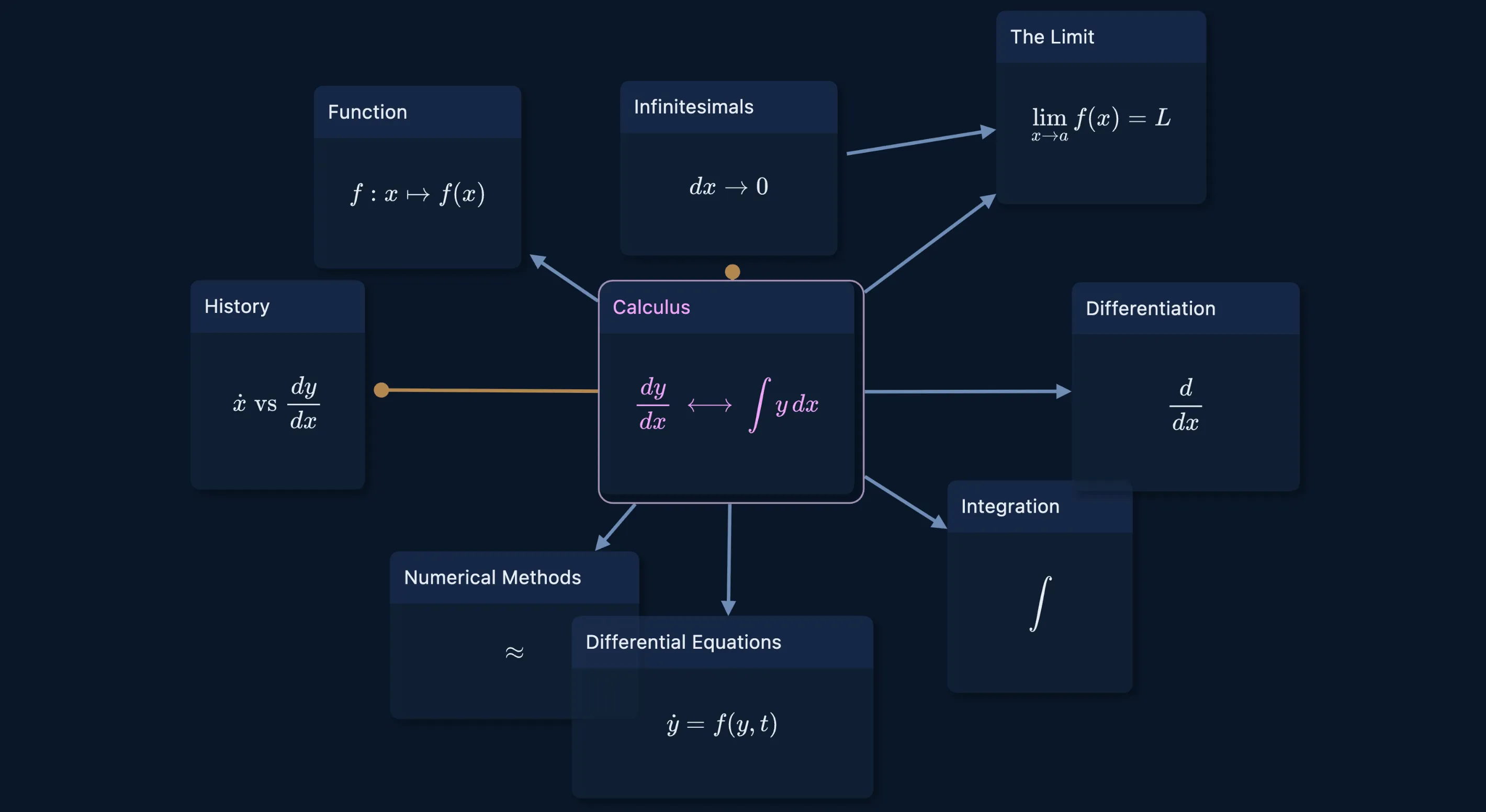
All of first-year calculus on one map — functions, limits, differentiation, integration, differential equations, and numerical methods, each node carrying its actual formula. A visual companion to your textbook: drill in scene by scene, following how each idea connects, instead of drowning in one flat diagram.
Opens in the browser — no account, nothing to install. Yours to edit once it's open,
or download the file to keep.
Graphs are built for a large screen — open this one on a desktop computer.
Everyone who has taken calculus has the same pile somewhere: lecture notes, worked problems, a
page of integration tricks, and a growing suspicion that all of it is secretly the same handful
of ideas wearing different clothes. Integration by parts is the product rule in reverse. The
Fundamental Theorem is the entire subject folded into one line. You know the connections are
there. You just can’t hold them all in your head at once, and a stack of paper is a terrible
place to keep a web.
This is that web, made visible. Every node carries its actual formula, so you are not reading
about the chain rule — you are looking at it, one step from the thing it depends on and the
thing it makes possible. The arrangement follows the way the course is taught rather than the
way a textbook indexes it: functions and limits first, because nearly everything downstream
leans on them, then differentiation, integration, differential equations, and numerical methods.
If you are revising, start at the branch you are weakest in and walk outward until the
connections start feeling obvious. If you are trying to understand rather than memorise, start
at limits and go in order. Numerical methods stands more or less on its own and can wait.
What it leaves out: multivariable calculus, and the analysis proofs that come later to justify
all of this. It is the first-year course as it is taught, not as it is eventually rebuilt.
Open it and it is yours. Pull a branch apart, add the examples your own lecturer used, or run a
quiz over the equations and find out how much of it actually stuck. There is a longer story
about why this map exists in The Calculus Map That Mermaid Couldn’t
Draw.
What's in this graph
The map opens on Calculus. These are the concepts branching from it — open one to
see the concepts inside it.
written article or notes
conversation with the AI assistant
Differentiation
7 children · 22 grandchildren · 9 neighbours
Applications of Differentiation
7 children: Optimization, Curve Sketching, Increasing and Decreasing, Kinematics, Related Rates …
10 grandchildren · 9 neighbours
Standard Derivatives
4 children: Derivative of e^x, Derivative of ln x, Power Rule, Trig Derivatives
4 grandchildren · 6 neighbours
Differentiation Rules
3 children: Linearity of the Derivative, Product Rule, Quotient Rule
1 grandchild · 5 neighbours
Higher Derivatives
1 child: Concavity
3 grandchildren · 4 neighbours
Maclaurin Series
2 children: Binomial Series, Euler's Formula
2 grandchildren · 7 neighbours
Implicit Differentiation
2 neighbours
Parametric Differentiation
2 neighbours
The Limit
10 children · 19 grandchildren · 13 neighbours
Derivative
3 children: Derivative Notation, Differentiability, Local Linearity
7 grandchildren · 13 neighbours
Continuity
1 child: Intermediate Value Theorem
1 grandchild · 4 neighbours
Definite Integral
6 neighbours
Epsilon–Delta Definition
5 neighbours
Indeterminate Forms
1 neighbour
Limits at Infinity
3 neighbours
Riemann Sums
4 neighbours
Small-Angle Approximations
4 neighbours
The Number e
2 neighbours
The Tangent Problem
3 neighbours
Integration
7 children · 18 grandchildren · 9 neighbours
Integration Techniques
5 children: Integration by Parts, Integration by Substitution, Logarithmic Integration, Partial Fractions, Trig Identities in Integration
7 grandchildren · 7 neighbours
Fundamental Theorem of Calculus
2 children: Mean Value Theorem for Integrals, Standard Integrals
2 grandchildren · 5 neighbours
Antiderivative
1 child: General and Particular Solutions
2 grandchildren · 5 neighbours
Applications of Integration
3 children: Areas Under and Between Curves, Mean Value of a Function, Volumes of Revolution
2 children: Radius of Convergence, Taylor's Theorem
6 neighbours
Trapezium Rule
1 child: Simpson's Rule
3 neighbours
Fixed-Point Iteration
1 neighbour
Newton–Raphson Method
3 neighbours
Root Location by Sign Change
2 neighbours
History
5 children · 5 grandchildren · 6 neighbours
Archimedes and Exhaustion
3 neighbours
Berkeley's Critique
3 neighbours
Leibniz and the Differential
4 neighbours
Newton and Fluxions
3 neighbours
Rigorization
3 neighbours
Infinitesimals
5 children · 4 grandchildren · 13 neighbours
Differentials
3 neighbours
Hyperreal Numbers
1 neighbour
Infinity
3 neighbours
Nonstandard Analysis
1 neighbour
Standard Part Function
1 neighbour
The shape of this map
A tree linking 118 ideas would need 117
connections. This map has 200. The extra 83 open alternative routes throughout.
The map runs 4 levels deep from its root. Any two ideas are about 3.9 steps apart, and the two most distant are 7.
Neighbouring ideas are linked to each other 17% of the time — themes hold together rather than radiating separately.
Connections are typed, not plain lines. They come in 7 kinds: Consists of, Leads to, related, Has type, Corresponds to, Explains, Has perspective.
Most routes through the map pass through Differentiation, Applications of Differentiation, Function, Derivative, Integration, Infinitesimals.
One node from the map
Calculus
Calculus is the mathematics of change. Before it existed, mathematics could describe the static world with great precision — lengths, areas, proportions, the geometry of things that hold still — but the moment something moved, grew, accelerated, or accumulated, the tools fell silent. A planet sweeping along its orbit, a quantity of heat draining from a cooling body, a population expanding into its territory: these are processes, not states, and describing a process requires answering a question that classical mathematics could not even pose cleanly. How fast is this changing right now — not on average over an hour, but at this very instant? And its mirror: if I know how fast something changes at every instant, what is the total effect over time?
These two questions define the subject's two great operations. Differentiation takes a quantity and extracts its instantaneous rate of change. Integration takes a rate and accumulates it back into a total. Asked separately, each is an ancient puzzle — the Greeks came within a hair of integration when they computed curved areas by exhaustion, and the tangent-line problem exercised geometers for centuries. The revolution of the 1660s–1680s, achieved independently by Newton and Leibniz, was not merely solving both problems but discovering that they are the same problem run in opposite directions. The slope of a curve and the area beneath a curve — two questions with no visible kinship whatsoever — turn out to be inverse to each other. That discovery, now called the Fundamental Theorem of Calculus, is the hinge on which the entire subject turns, and it is the reason calculus is one subject rather than two. If you retain a single idea from this material, let it be that one. …
This continues inside the graph, along with 117 other nodes.