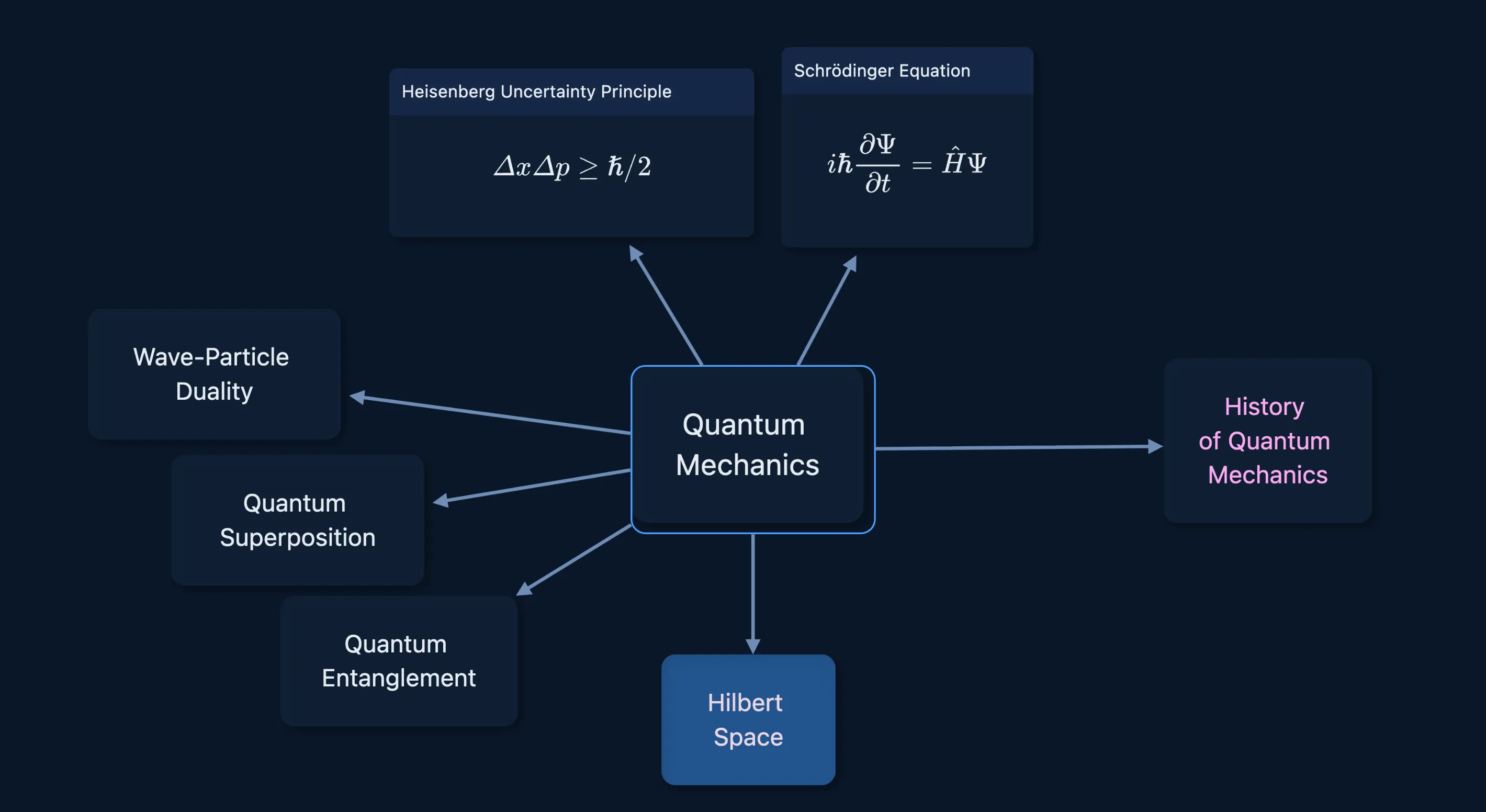
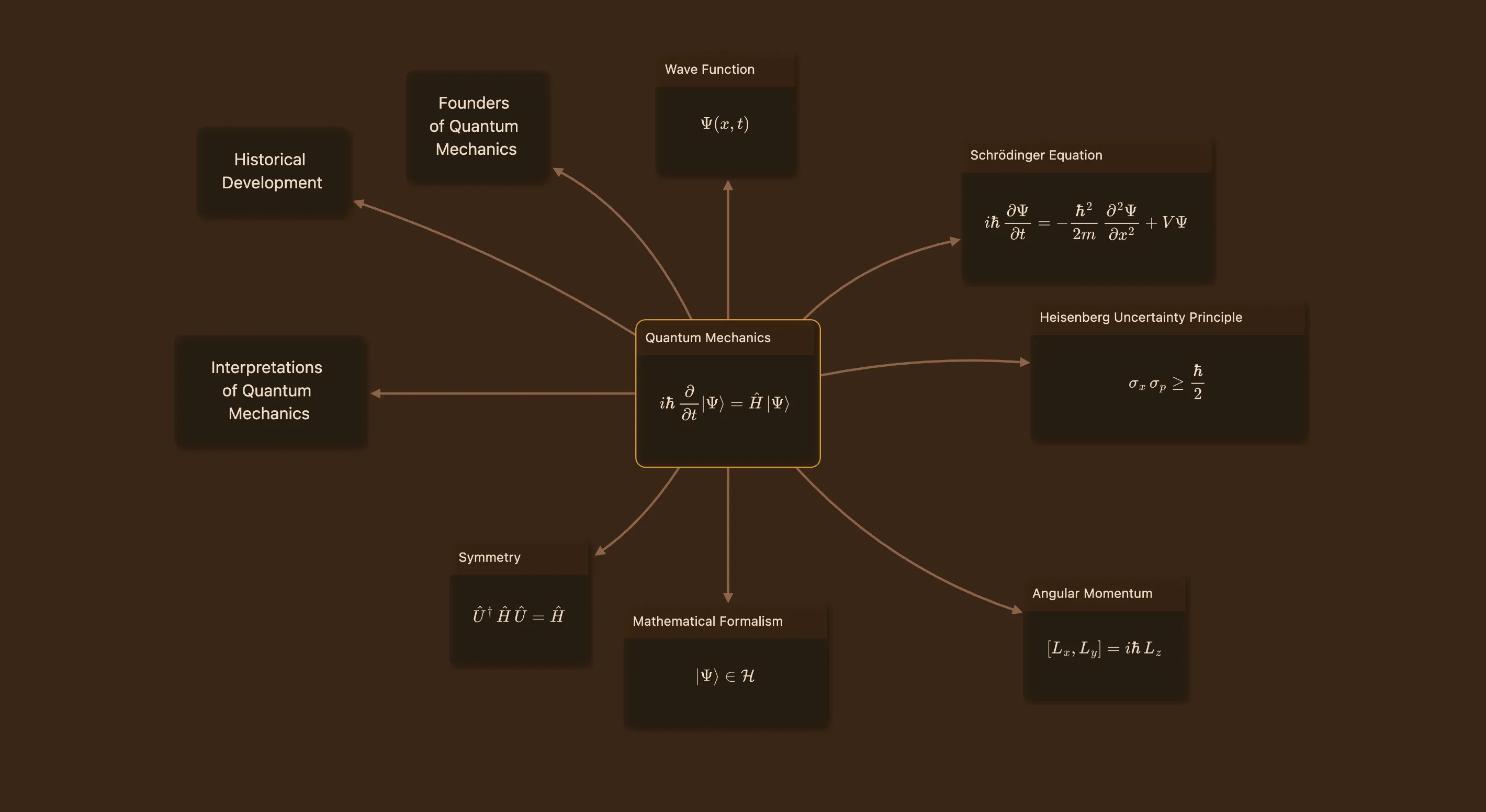
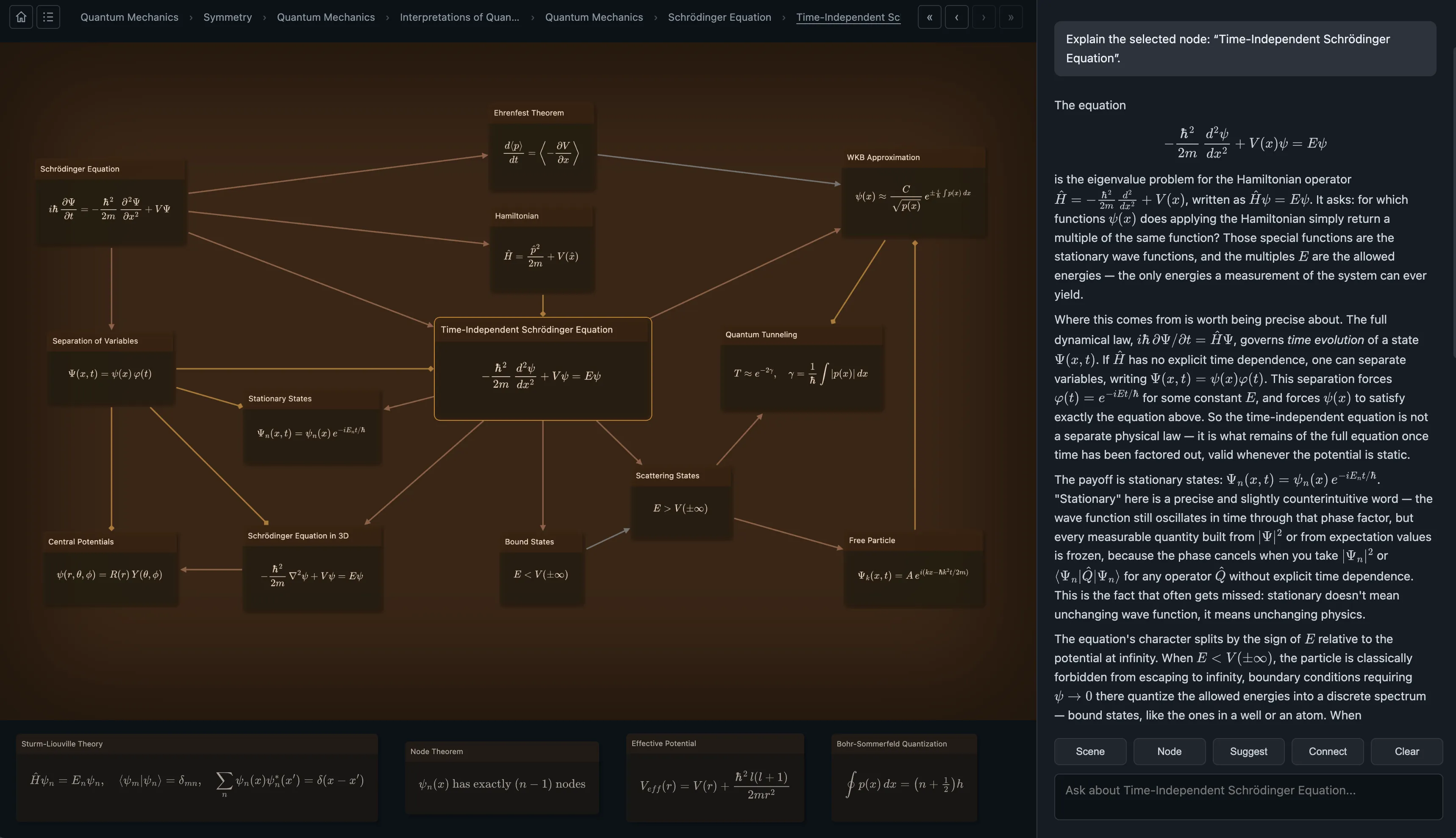
An undergraduate introduction to quantum mechanics, built as a connected map rather than a linear text. Walk from the Schrödinger equation through wave functions, superposition, operators and observables, the uncertainty principle, and spin — each node carrying its own equation, worked scene by scene so the structure stays visible.
Opens in the browser — no account, nothing to install. Yours to edit once it's open,
or download the file to keep.
Graphs are built for a large screen — open this one on a desktop computer.
Do you remember the professor at the blackboard? Three sliding boards, the top one already full,
the Schrödinger equation somewhere up in a corner, and by the time the derivation reaches the
part you actually needed, the line it started from has been rolled out of sight. So you copy
symbols and hope the connection between them arrives later. Sometimes it does.
This map is that lecture with the boards kept. Every node carries its own equation, and the
links between them are the ones the professor drew in the air with a piece of chalk and then
erased — wave functions to superposition, operators to observables, uncertainty falling out of
the commutator rather than being announced. There is more than one route from any equation to
any other, which is the whole point: you can walk it the way your understanding actually goes,
not the order the syllabus happened to impose.
And because it is yours the moment you open it, you can rearrange it. Split a node that is doing
too much work. Pull two ideas together that your course kept a term apart. Add the derivation
step that got skipped. When you want to know whether any of it has stuck, run a quiz over the
equations instead of re-reading them and feeling vaguely confident.
It is written for a first undergraduate course and assumes calculus and a little linear algebra
— if the calculus is the shaky part, that map is here too. Field theory,
relativistic mechanics and the deeper interpretation debates are deliberately outside it.
What's in this graph
The map opens on Quantum Mechanics. These are the concepts branching from it — open one to
see the concepts inside it.
written article or notes
conversation with the AI assistant
Founders of Quantum Mechanics
The collection of physicists who created quantum mechanics between 1900 and the mid-twentieth century.
12 children · 30 grandchildren · 13 neighbours
Albert Einstein
The German-born physicist (1879–1955) who established the reality of light quanta and later challenged quantum mechanics' completeness.
2 children: Bose-Einstein Condensate, EPR Paradox
6 grandchildren · 8 neighbours
Wolfgang Pauli
The Austrian physicist (1900–1958) who formulated the exclusion principle and the spin matrices.
1 child: Pauli Exclusion Principle
5 grandchildren · 5 neighbours
Erwin Schrödinger
The Austrian physicist (1887–1961) who formulated the wave equation of quantum mechanics.
5 neighbours
John Bell
The Northern Irish physicist (1928–1990) whose theorem made the reality of quantum nonlocality experimentally testable.
3 neighbours
John von Neumann
The Hungarian-American mathematician (1903–1957) who built quantum mechanics' rigorous mathematical foundations.
3 neighbours
Louis de Broglie
The French physicist (1892–1987) who proposed that matter has wave properties.
4 neighbours
Max Born
The German physicist (1882–1970) who gave the wave function its probabilistic interpretation.
4 neighbours
Max Planck
The German physicist (1858–1947) who introduced the quantum of energy in 1900.
4 neighbours
Niels Bohr
The Danish physicist (1885–1962) who quantized the atom and led the Copenhagen school of quantum interpretation.
5 neighbours
Paul Dirac
The English physicist (1902–1984) who unified quantum mechanics with relativity and predicted antimatter.
3 neighbours
… and 2 more under Founders of Quantum Mechanics
Historical Development
The historical narrative of quantum mechanics from the first quantum hypothesis to the present, told through its major milestones.
9 children · 32 grandchildren · 12 neighbours
Second Quantum Revolution (1935– )
The ongoing era, begun in foundational debates, in which entanglement became an experimental and technological resource.
2 children: EPR Paper (1935), Qubit
8 grandchildren · 5 neighbours
Bohr's Atom (1913)
The 1913 historical milestone introducing quantized electron orbits to explain atomic spectra.
2 children: Hydrogen Spectrum, Rutherford's Nuclear Atom (1911)
6 grandchildren · 8 neighbours
Discovery of Spin (1922–1928)
The 1922–1928 historical development in which intrinsic particle spin was observed, hypothesized, and derived.
The family of proposed answers to what is physically happening beneath quantum mechanics' successful predictions.
7 children · 12 grandchildren · 8 neighbours
Pilot-Wave Theory
The interpretation giving every particle a definite trajectory guided deterministically by the wave function.
2 children: Bell's Theorem, Hidden Variables
3 grandchildren · 4 neighbours
Copenhagen Interpretation
The interpretation treating the wave function as a calculational tool, collapse as fundamental, and classical apparatus as a given.
3 neighbours
Many-Worlds Interpretation
The interpretation removing collapse so that measurement splits observers into branches, one per outcome.
3 neighbours
Measurement Problem
The open question of where deterministic wave evolution hands over to probabilistic collapse, and what physically constitutes a measurement.
5 neighbours
Objective Collapse Theories
The family of theories modifying quantum dynamics with rare spontaneous localizations that suppress macroscopic superpositions.
3 neighbours
QBism
The interpretation reading quantum states as an agent's personal degrees of belief about future experiences.
3 neighbours
Solvay Conference (1927)
The 1927 gathering of quantum theory's founders famous for the debates over the theory's completeness.
3 neighbours
The shape of this map
A tree linking 171 ideas would need 170
connections. This map has 434. The extra 264 open alternative routes throughout.
The map runs 5 levels deep from its root. Any two ideas are about 3.7 steps apart, and the two most distant are 8.
Neighbouring ideas are linked to each other 20% of the time — themes hold together rather than radiating separately.
Connections are typed, not plain lines. They come in 8 kinds: Enables, Leads to, Associated with, Consists of, Precedes, Has special case, Has perspective, related.
Most routes through the map pass through Historical Development, Founders of Quantum Mechanics, Schrödinger Equation, Wave Function, Bohr's Atom (1913), Symmetry.
One node from the map
Quantum Mechanics
Quantum mechanics has a strange reputation problem. It is, by any measure, the most successful physical theory ever constructed: its predictions have been verified to eleven decimal places, it underlies roughly a third of the world economy — every transistor, laser, LED, MRI scanner, and atomic clock is quantum engineering — and in a century of increasingly aggressive experimental interrogation it has never once been caught in an error. And yet it is routinely described, including by the people who built it, as incomprehensible. Feynman's famous line — that nobody understands quantum mechanics — was not false modesty. It named a real situation: we possess a theory whose use we have mastered completely and whose meaning we still argue about.
Both halves of that situation are worth your attention, and this workspace takes both seriously. The usable half is a body of concrete, learnable machinery: a handful of postulates, a menu of exactly solvable systems, a toolkit of approximation methods that handle everything else. The mysterious half is not decoration — it is a set of sharp, unresolved questions that sit inside the theory like a splinter, and wrestling with them honestly is part of learning the subject, not a distraction from it. …
This continues inside the graph, along with 170 other nodes.